
Summary
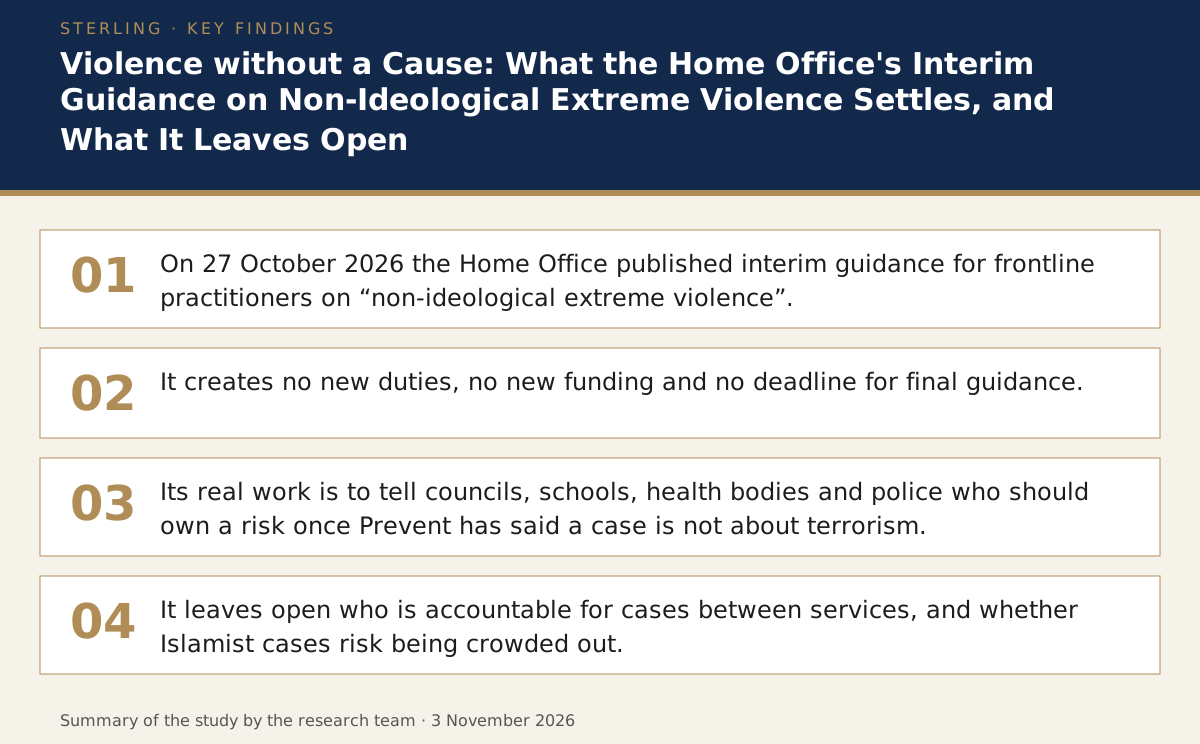
On 27 October 2026 the Home Office published interim guidance for frontline practitioners on "non-ideological extreme violence" (Home Office 2026c). The document is dated as issued on 8 October, 19 days before it appeared on GOV.UK; we have found no published explanation for the gap. So far as we are aware, it is the government's first published working definition of violence that is "not driven by a clear ideological purpose" but is meant to shock, intimidate or outrage the public. It is also the clearest admission so far that a large share of the people now coming to the attention of counter-extremism services do not fit the categories the system was built around.
The guidance is careful and modest. It creates no new duties, no new funding and no deadline for final guidance. Its real work is to tell councils, schools, health bodies and police who should own a risk once Prevent has said that a case is not about terrorism. This paper argues that the guidance is a sensible stopgap, but that it raises three questions the Lovegrove review, the Southport Inquiry and the first State of Extremism report will all have to answer: who is accountable for cases that fall between services, how ideological and non-ideological casework should be kept apart without either being neglected, and whether Islamist and other ideologically driven cases risk being crowded out of a system increasingly occupied by violence-fixated young people.
1. What has been published
The guidance is short, at a little over 2,500 words in its accessible version. Its scope is narrow by design. It applies "where there are NIEV-related concerns, but the person is not considered at risk of becoming involved in, or supporting, terrorism" (Home Office 2026c, para. 2). Anyone thought to be at risk of terrorism should still be referred to Prevent "in the usual way", and the guidance repeats the line, now standard in Home Office material, that "a clearly identifiable ideology is not mandatory for a Prevent referral" (Home Office 2026c, paras 2 and 16).
The working definition reads: "The use or threat of extreme violence, not driven by a clear ideological purpose, which is communicative in nature and intended to shock, intimidate or outrage the public or a section of the public" (Home Office 2026c, para. 6). The Home Office is explicit that this definition "is not statutory, legal, or operational in nature". It is a planning tool, not a legal test.
Four "common features" are listed: intense grievance; hatred towards humankind or society; a fascination with violence, including admiration for past attackers; and participation in violent online environments. The last of these names the "True Crime Community", which the guidance distinguishes from ordinary interest in true-crime documentaries, as well as "coercive sadistic networks" and the wider "edgesphere" of online subcultures that "normalize, celebrate, and commodify violence, trauma, and sadism" (Home Office 2026c, para. 8 and notes 4–5). The risk factors most often present in current evidence are said to be younger age, neurodiversity, mental health difficulties, social isolation and adverse life experiences, though the guidance warns that these "are not predictive or causal in isolation" (Home Office 2026c, para. 7).
The document is candid about the weakness of its own evidence base. A footnote records that understanding of this kind of violence "is derived from a relatively small number of cases, varying international approaches and a developing body of research", and that the Home Office is "reliant on existing evidence on risk assessment from terrorism, extremism and wider violence literature" (Home Office 2026c, note 2). The guidance cites a "Non-Ideological Extreme Violence (NIEV) Document Review" carried out for the Home Office by the research company Verian and dated September 2026 (Home Office 2026c, note 3). We have found no published copy.
2. Why now
The guidance is the latest step in a sequence that began with the Southport murders of July 2024. The Home Secretary, Shabana Mahmood, told the House of Commons on 12 October that, "following the horrors of Southport", the government had strengthened "the handling of repeat Prevent referrals" and made clear that "referrals can be made to Prevent without a clearly identifiable ideology" (Home Office 2026b). The guidance says in terms that it does not seek to pre-judge Phase 2 of the Southport Inquiry, which is examining arrangements in England and Wales for managing people at risk of extreme violence "where ideology is not the primary driver" (Home Office 2026c, para. 5).
The pressure on the system is not in doubt. Our baseline snapshot of 26 October recorded that Prevent referrals had reached a record 10,293 in the year to September 2025. Of the 10,282 referrals where a type of concern was recorded, 56 per cent had no clear ideology and 8 per cent were classed as Islamist (Home Office 2026d; Wong 2026a). Whatever view one takes of those proportions, a counter-terrorism safeguarding programme in which more than half of all referrals involve no identifiable cause is carrying a load it was not designed for. The interim guidance is, in effect, the Home Office's first attempt to route part of that load elsewhere.
3. What the guidance gets right
Three features deserve credit.
First, it insists on ownership. When a case is transferred, referred or closed, practitioners are told to record the decision and rationale, the onward route, and "confirmation that the receiving service has formally accepted responsibility" (Home Office 2026c, para. 13). Where no single agency can take ownership, partners should agree a lead agency and a joint plan; unresolved risk "should be escalated", and possible public protection risks should be notified to local policing (Home Office 2026c, para. 14). A written hand-off with a named recipient is a simple safeguard against cases drifting between services with no one accountable for them.
Second, it corrects a dangerous misreading of Prevent decisions. A decision by counter-terrorism police that someone does not meet the Prevent threshold "should not be interpreted as a judgement that the person poses no wider risk of violence or harm" (Home Office 2026c, para. 17). The guidance thus warns against reading a Prevent "no" as an all-clear (Home Office 2026c, para. 17), and stating this plainly matters.
Third, it gives weight to schools. Drawing on Phase 1 of the Southport Inquiry, it says that where police consider the risk a child may pose, the view of the child's school "should be actively sought where relevant, properly considered, and given appropriate weight" (Home Office 2026c, para. 12). Teachers often see a pattern of behaviour long before any other agency does.
The case studies are useful because they are local and practical: an enhanced Multi-Agency Safeguarding Hub in Northumberland, screening tools under development in Birmingham, and a non-statutory panel in Cardiff for people below the Prevent threshold whose lower-level risks remain (Home Office 2026c, paras 10, 11 and 16).
4. Where the gaps are
4.1 Guidance without resources
The guidance "does not create new statutory duties, structures or processes" (Home Office 2026c, para. 3). It encourages partners to use existing arrangements and allows, but does not require, new local panels. That is a reasonable position for interim guidance. It also means the Cardiff and Northumberland models depend on local authorities that choose to fund them. No new money is attached. Where councils, children's services and mental health services are already stretched, the most likely outcome is variation: some areas will build a proper pathway for these cases and others will not.
4.2 The boundary with ideology is still blurred
The guidance asks practitioners to keep two ideas in mind at once. Ideology is not needed for a Prevent referral, yet Prevent is only for people at risk of terrorism. Fascination with violence, it notes, "is seen in both non-ideological casework and ideological casework" (Home Office 2026c, para. 8). In practice, the hardest cases are mixed: young people who move between misogynist, jihadist, extreme right-wing and nihilist content online, sometimes in a single week. The definition's phrase "not driven by a clear ideological purpose" will be tested most by those cases. The guidance tells practitioners to consider a Prevent referral where "Prevent relevance is uncertain" (Home Office 2026c, para. 16). That is prudent, but it will push more uncertain cases back towards the programme the guidance is meant to relieve.
4.3 The risk of crowding out
For a government audience concerned with Islamist extremism, the most important question is one the guidance does not address: capacity. Prevent's specialist resource is finite. If a growing share of it is spent assessing and then signposting violence-fixated cases with no ideology, there is a real risk that slower-burning ideological cases, including Islamist radicalisation that rarely shows itself through overt violence fascination, receive less attention. The government's own framing points the same way. Its national security statement of 12 October set individuals "fixated on violence" alongside terrorism, extremism and state-directed proxy activity as parts of a single threat picture (Home Office 2026b). A single picture is right. A single queue would not be.
The first annual State of Extremism report, promised in Protecting What Matters, is the natural place to show whether this is happening. It should publish, at minimum, the time taken to assess referrals by category, the share of cases adopted at Channel panel by category, and the outcomes for cases signposted out of Prevent.
4.4 Information sharing
The guidance restates that data protection law "supports the timely and proactive sharing of information to prevent harm", and that "public task", "legal obligation" or "recognised legitimate interests" will often be better lawful bases than consent (Home Office 2026c, para. 19). That is correct, but practitioners have heard it before. Reluctance to share usually comes from uncertainty about liability, not ignorance of the law. A short, jointly badged note from the Information Commissioner's Office and the Home Office for this specific category of case would do more than a further restatement.
5. How this fits with the wider review cycle
The guidance arrives in a crowded field. On 12 October the Home Secretary announced a review of protective security for people in public life, led by Sir Stephen Lovegrove, a former national security adviser, which is to report within six months (Home Office 2026a; Wong 2026b). Sir Robert Buckland's review into the killing of Sir David Amess continues. Phase 2 of the Southport Inquiry is under way. The term of the Independent Reviewer of Terrorism Legislation, Jonathan Hall, ran to November 2026; the public appointments competition for a successor closed on 17 July 2026 (Cabinet Office 2026). At the time of writing, we have found no announcement of the new appointment.
These processes overlap. Grievance-driven and fixated individuals are a central concern of protective security for public figures, not only of safeguarding. A person fixated on a politician will often fit the guidance's description of "intense grievance" without any ideology. Ministers would be wise to ensure that the Lovegrove review and the final version of this guidance use the same vocabulary and the same referral routes, rather than producing two parallel systems.
6. Recommendations
- Set a date for final guidance, tied to the publication of the Southport Inquiry's Phase 2 findings, and say so publicly.
- Publish the Verian document review cited in the guidance, so that practitioners and researchers can test its findings.
- Fund a small number of pathfinder areas on the Cardiff and Northumberland models and evaluate them before any national roll-out.
- Report capacity by category in the first State of Extremism report, so that Parliament can see whether ideological casework, including Islamist casework, is being displaced.
- Align the vocabulary of the final guidance with the Lovegrove review's work on fixated individuals and protective security.
- Issue joint practical advice on information sharing with the Information Commissioner's Office for non-ideological cases.
Conclusion
The interim guidance does a modest job well. It names a problem that frontline services already know, refuses to overstate the evidence, and closes one of the most dangerous gaps in the system: the assumption that a case turned down by Prevent is no longer anyone's concern. Its weakness is that it shifts responsibility without shifting resources. The test for ministers over the coming year is whether a system now being asked to handle violence with no cause can do so without losing sight of violence that has one.
References
Cabinet Office. 2026. "Independent Reviewer of Terrorism Legislation: Appointment Details." Apply for a Public Appointment, GOV.UK. Accessed 3 November 2026. https://apply-for-public-appointment.service.gov.uk/roles/9404.
Home Office. 2026a. "Root-and-Branch Review of Security for Those in Public Life." GOV.UK, 12 October 2026. https://www.gov.uk/government/news/root-and-branch-review-of-security-for-those-in-public-life.
Home Office. 2026b. "National Security." Oral statement to the House of Commons by the Home Secretary, 12 October 2026. GOV.UK. https://www.gov.uk/government/speeches/home-secretary-oral-statement-on-national-security.
Home Office. 2026c. Interim Guidance to Support the Management of Non-Ideological Extreme Violence Concerns. Date of issue 8 October 2026; published 27 October 2026. GOV.UK. https://www.gov.uk/government/publications/non-ideological-extreme-violence-interim-guidance.
Home Office. 2026d. "Individuals Referred to and Supported through the Prevent Programme, October 2024 to September 2025." Official statistics. GOV.UK. https://www.gov.uk/government/statistics/individuals-referred-to-prevent-to-september-2025/individuals-referred-to-and-supported-through-the-prevent-programme-october-2024-to-september-2025.
Wong, Vicky. 2026a. "Referrals to Prevent Anti-Terror Scheme at Record High." BBC News, 6 August 2026. https://www.bbc.com/news/articles/c3r072j10zlo.
Wong, Vicky. 2026b. "Government Expands Police Support to Political Figures Who Are Not MPs." BBC News, 12 October 2026. https://www.bbc.com/news/articles/c3gr82rk70l8o.