
Summary
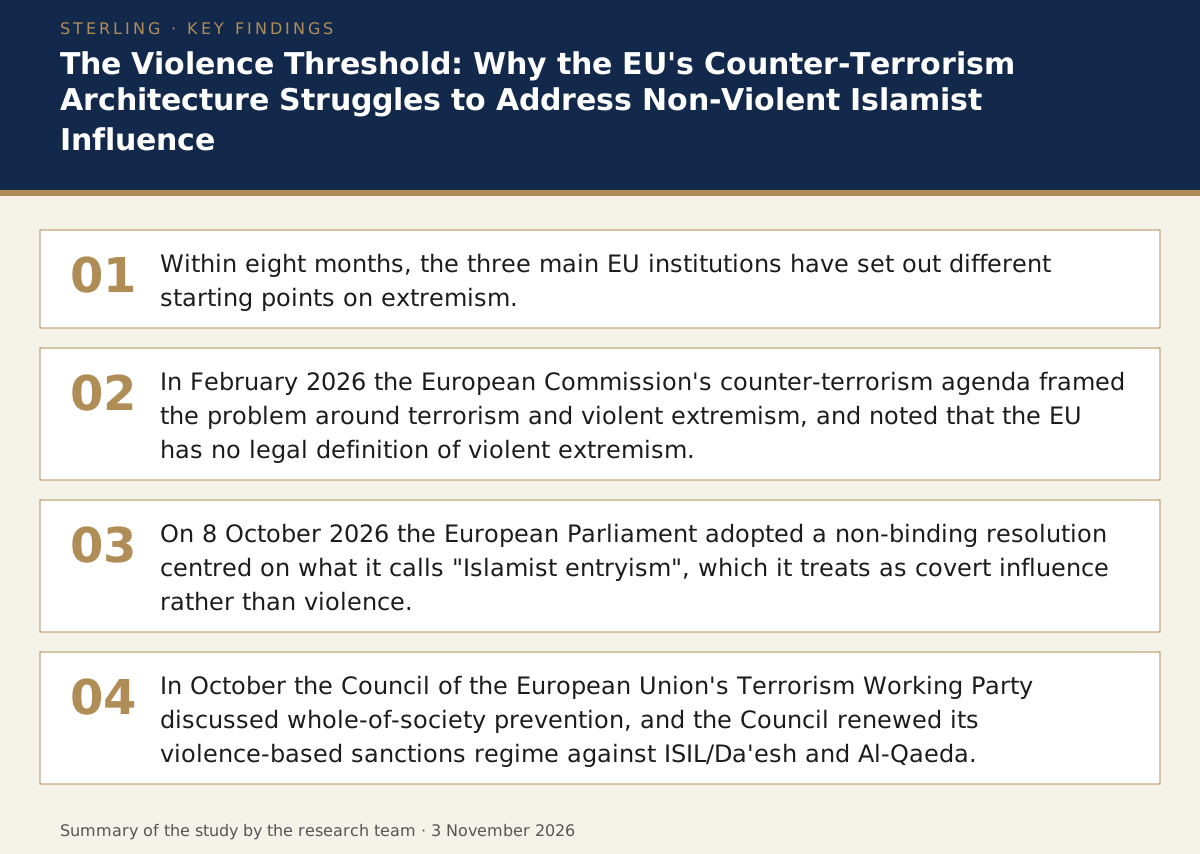
Within eight months, the three main EU institutions have set out different starting points on extremism. In February 2026 the European Commission's counter-terrorism agenda framed the problem around terrorism and violent extremism, and noted that the EU has no legal definition of violent extremism (European Commission 2026). On 8 October 2026 the European Parliament adopted a non-binding resolution centred on what it calls "Islamist entryism", which it treats as covert influence rather than violence (European Parliament 2026). In October the Council of the European Union's Terrorism Working Party discussed whole-of-society prevention (Council of the European Union 2026a), and the Council renewed its violence-based sanctions regime against ISIL/Da'esh and Al-Qaeda (Council of the European Union 2026b). This paper argues that the main policy question for member-state governments is not designation. It is whether EU tools built around a violence threshold can be adapted, lawfully and proportionately, to the conduct the Parliament has described.
1. Three institutions, three framings
The European Commission (February 2026). The Commission's communication ProtectEU: Agenda to prevent and counter terrorism, COM(2026) 101 final, was dated 26 February 2026 and forwarded to the Council the next day (European Commission 2026). It describes jihadist terrorism as "the most prominent and lethal terrorist threat". It reports that terrorist incidents in the EU more than doubled between 2019 and 2023 (from 57 to 120) before falling to 58 in 2024. It also reports that almost a third of terrorist suspects in 2024 were under 20. In a footnote, it states that "there is no legal definition of violent extremism at EU level". On prevention, the agenda relies on the EU Knowledge Hub on Prevention of Radicalisation, set up in June 2024 with EUR 60 million over four years. Its Strategic Orientations are due to be updated in 2027 (European Commission 2026).
The European Parliament (8 October 2026). Resolution 2026/2868(RSP), adopted text P10_TA(2026)0342, was adopted by 381 votes to 167, with 15 abstentions. It is a resolution, not a ban, and it has no binding legal effect (European Parliament Legislative Observatory 2026). It condemns entryism as "covert and malicious interference" and, in the Legislative Observatory's summary, sees it operating through associations, foundations and educational, charitable and social bodies "rather than solely through formal membership" (European Parliament Legislative Observatory 2026). It calls for a European methodology to identify signs of entryism, including "institutional doublespeak", "financial opacity" and "the recurrence of certain partnerships" (European Parliament 2026, para. 6). In recital C, the resolution also states that Islam as a religion "is not inherently political or hostile", and that criticism of a political ideology must not be equated with an attack on a religion (European Parliament 2026, recital C). Its other requests cover EU funding (paras. 18–24), terrorist listing (para. 15), institutional access and the Transparency Register (para. 12) and face coverings (para. 8).
The Council of the European Union (October 2026). The provisional agenda of the Terrorism Working Party for 9 October 2026 included, among other items, a presentation by the EU Counter-Terrorism Coordinator on "EU counter-terrorism 25 years after 9/11". and an exchange of views on "community based approaches to countering radicalisation in a 'whole-of-society' framework", with presentations from the EU Knowledge Hub, Ireland, Latvia and Denmark (Council of the European Union 2026a). On 26 October 2026 the Council extended its autonomous ISIL/Da'esh and Al-Qaeda restrictive measures until 31 October 2027. That list covers 15 persons and 8 groups (Council of the European Union 2026b; Council of the European Union 2026c).
2. The gap
These texts do not contradict one another, but they work at different thresholds:
- Criminal law and sanctions require terrorist offences as defined in Directive (EU) 2017/541. For the EU terrorist list under Common Position 2001/931/CFSP, they also require a decision by a competent national or third-country authority (Council of the European Union 2001, art. 1(4); European Parliament 2025).
- Prevention policy in the Commission's agenda covers violent extremism, which sits below the terrorism threshold but is still defined by violence.
- The Parliament's concern sits below both. It is about lawful-seeming organisational conduct that, in the Parliament's view, erodes democratic institutions.
The one EU-level instrument that clearly reaches conduct short of violence is budgetary. Under Article 138 of the Financial Regulation, Regulation (EU, Euratom) 2024/2509, the Commission may exclude an entity from EU funds for "incitement to discrimination, hatred or violence against a group of persons ... or similar activities that are contrary to the values ... enshrined in Article 2 TEU". This applies only where the conduct affects the entity's integrity and the performance of the funded commitment, and it is subject to proportionality (European Union 2024; European Commission, n.d.).
3. Policy options for member-state governments
- Use the 2027 Knowledge Hub review. Member states set the Hub's Strategic Orientations. The 2027 update is the natural, low-cost forum to ask for evidence-based work on non-violent pathways into extremism, without creating a new legal category.
- Insist on a shared evidential standard before any "entryism methodology". The Parliament's proposed indicators, such as doublespeak and recurring partnerships, are open to subjective application. Any EU methodology should be tied to verifiable conduct and reviewable decisions, so that it withstands challenge under the Charter of Fundamental Rights.
- Treat funding integrity as the main lever, separate from designation. The Financial Regulation exclusion route already exists and is reviewable. Governments can ask the Commission to report on how the Article 2 TEU exclusion ground has been used since it became applicable on 30 September 2024.
- Watch the Commission's reply. Under point 16 of the 2010 Framework Agreement on relations between the European Parliament and the European Commission, the Commission must report in writing within three months on action taken on a resolution's specific requests, extendable by one month; it is not obliged to legislate (European Parliament and European Commission 2010). A reply is therefore due around 8 January 2027, or about 8 February 2027 if extended.
4. What to watch (November 2026 to January 2027)
- The Commission's written follow-up to resolution 2026/2868(RSP).
- Any Council working-party outcome documents following the 9 October exchange.
- Preparation of the 2027 Knowledge Hub Strategic Orientations.
References
Council of the European Union. 2026a. "Notice of Meeting and Provisional Agenda: Terrorism Working Party (TWP), 9 October 2026." CM 4187/26, 29 September. https://data.consilium.europa.eu/doc/document/CM-4187-2026-INIT/en/pdf.
Council of the European Union. 2026b. "EU Sanctions against ISIL/Da'esh and Al-Qaeda: Council Renews Regime until 2027." Press release, 26 October. https://www.consilium.europa.eu/en/press/press-releases/2026/10/26/eu-sanctions-against-isilda-esh-and-al-qaeda-council-renews-regime-until-2027/.
Council of the European Union. 2026c. Council Decision (CFSP) 2026/2378 of 26 October 2026 (renewal of restrictive measures against ISIL/Da'esh and Al-Qaeda). Official Journal of the European Union L, 27 October 2026. https://eur-lex.europa.eu/legal-content/EN/TXT/PDF/?uri=OJ%3AL_202602378.
Council of the European Union. 2001. Council Common Position 2001/931/CFSP of 27 December 2001 on the Application of Specific Measures to Combat Terrorism. Official Journal of the European Communities L 344, 28 December 2001, 93–96. https://eur-lex.europa.eu/legal-content/EN/TXT/?uri=CELEX:32001E0931.
European Commission. 2026. ProtectEU: Agenda to Prevent and Counter Terrorism. COM(2026) 101 final, 26 February. Transmitted as Council document 6763/26. https://data.consilium.europa.eu/doc/document/ST-6763-2026-INIT/en/pdf.
European Commission. n.d. "EDES." Accessed 3 November 2026. https://commission.europa.eu/strategy-and-policy/eu-budget/how-it-works/annual-lifecycle/implementation/anti-fraud-measures/edes_en.
European Parliament. 2025. "Inclusion of the Muslim Brotherhood in the EU List of Persons, Groups and Entities Involved in Terrorist Acts (Council Decision 2001/931/CFSP)." Question for written answer E-004796/2025, 2 December. https://www.europarl.europa.eu/doceo/document/E-10-2025-004796_EN.html.
European Parliament. 2026. "Resolution of 8 October 2026 on the Need for an EU Strategy to Counter Islamist Entryism and the Influence of the Muslim Brotherhood Network (2026/2868(RSP))." P10_TA(2026)0342. https://www.europarl.europa.eu/doceo/document/TA-10-2026-0342_EN.html.
European Parliament and European Commission. 2010. "Framework Agreement on Relations between the European Parliament and the European Commission." Official Journal of the European Union L 304, 20 November 2010, 47–62. https://eur-lex.europa.eu/legal-content/EN/TXT/?uri=CELEX:32010Q1120(01).
European Parliament Legislative Observatory. 2026. "The Need for an EU Strategy to Counter Islamist Entryism and the Influence of the Muslim Brotherhood Network, 2026/2868(RSP): Document Summary." 8 October. https://oeil.europarl.europa.eu/oeil/en/document-summary?id=1919148.
European Union. 2024. Regulation (EU, Euratom) 2024/2509 of the European Parliament and of the Council of 23 September 2024 on the Financial Rules Applicable to the General Budget of the Union (Recast). Official Journal of the European Union L, 2024/2509. https://eur-lex.europa.eu/eli/reg/2024/2509/oj/eng.