
Summary
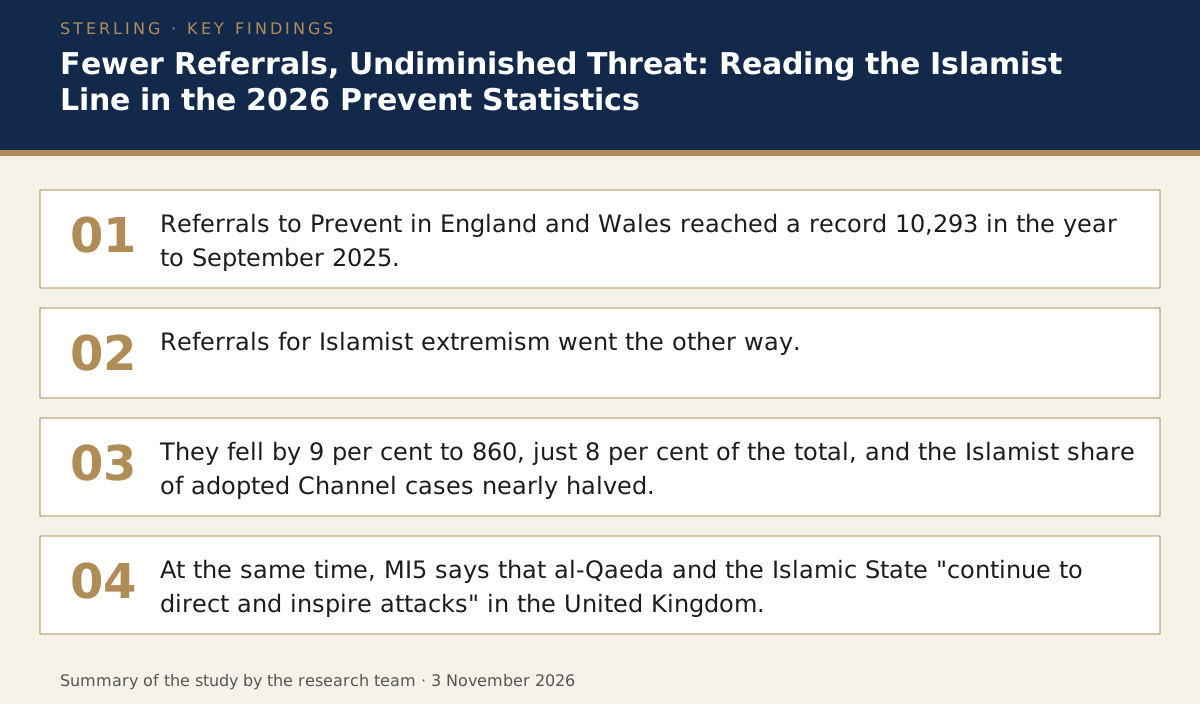
Referrals to Prevent in England and Wales reached a record 10,293 in the year to September 2025. Referrals for Islamist extremism went the other way. They fell by 9 per cent to 860, just 8 per cent of the total, and the Islamist share of adopted Channel cases nearly halved. At the same time, MI5 says that al-Qaeda and the Islamic State "continue to direct and inspire attacks" in the United Kingdom. This paper argues that the falling number is better read as a sign of where Prevent's attention has moved than as evidence that the Islamist threat is receding. It sets out the questions government should ask before drawing conclusions from it.
1. What the figures show
The Home Office's statistics, published on 6 August 2026, record 10,293 referrals to Prevent in the year ending September 2025. That is 39 per cent more than the previous year and the highest figure since the series began in 2015 (Home Office 2026). Within that total:
- Islamist extremism referrals fell by 9 per cent, from 945 to 860, even as overall referrals rose. Extreme right-wing referrals rose by 42 per cent to 2,103 (Home Office 2026).
- The Islamist share of adopted Channel cases fell from 22 per cent to 12 per cent (212 of 1,807). The extreme right wing accounted for 42 per cent (Home Office 2026).
- Islamist referrals that reached a Channel panel were adopted at the same high rate as extreme right-wing ones, 88 per cent (212 of 240). This suggests that the Islamist cases that do surface are generally judged serious (Home Office 2026).
- The Islamist cohort is older. Among Islamist referrals the largest age group was 31 to 40 (19 per cent), while those aged 11 to 15 made up 18 per cent. Across all referrals, 11 to 15-year-olds were the largest group at 36 per cent (Home Office 2026).
- Consent is weaker. Only 50 per cent (104 of 206) of adopted Islamist cases consented to Channel support, compared with 57 per cent for extreme right-wing cases (Home Office 2026).
- "No ideology" categories dominate. These accounted for 56 per cent of all referrals but had a Channel adoption rate of only 7 per cent (Home Office 2026).
The Children's Commissioner for England's analysis of 2024–25 referrals points the same way. Islamist extremism accounted for 7.7 per cent of referrals for children (364), compared with 12 per cent for adults (502). Seventy-one per cent of referrals for children had no clear ideology (Children's Commissioner for England 2026a; 2026b).
More recent police data have also emerged. The Daily Telegraph and the Daily Mail reported on 26–27 October 2026 that National Police Chiefs' Council figures, obtained by the Conservative Party under freedom of information law, showed 6,085 under-18s referred to Prevent in 2025, up from 2,129 in 2020 (Hymas 2026; Barrett 2026). The police response has not been published, and the figure rests on these press reports. These are calendar-year police figures and cannot be compared directly with the Home Office series. For context, the Children's Commissioner's analysis of Home Office data counts 4,715 referrals for children in 2024–25 (Children's Commissioner for England 2026b).
2. What the figures do not show
The Home Office itself warns that the type-of-concern categories changed with the new Prevent Case Management Tracker, which creates "a break in the time series". It also says that the recorded concern reflects what the referrer reported, which may later be revised (Home Office 2026). A referral measures what teachers, police officers, clinicians and families notice and report. It does not measure how many people are being radicalised. Three caveats follow.
First, attention follows salience. The Home Office links the surge in referrals partly to public awareness after the Southport attack and the trial in January 2025. Lord Anderson, the previous Independent Prevent Commissioner, attributed the spike in the first quarter of 2025 to publicity around that trial (Home Office 2026). Referrals for violence fixation have risen sharply, peaking at 286 between April and June 2025 (Home Office 2026). If the system's capacity and the attention of referrers are absorbed by these cases, a falling Islamist line may partly reflect where referrers are looking.
Second, Islamist risk may sit outside Prevent's natural catchment. The older age profile of Islamist referrals and the lower consent rate suggest a cohort that schools are less likely to see and that is less willing to engage. Prevent depends on education settings, which made 34 per cent of all referrals (Home Office 2026). It is likely to capture Islamist radicalisation among adults less well.
Third, the security services' assessment has not moved in step. On 13 October 2026 the Director General of MI5 said that "Al Qaida and Islamic State continue to direct and inspire attacks". He said MI5 is "still having to respond to attempts to carry out mass casualty attacks in the UK", and noted that three Islamist extremists were convicted in February 2026 of planning to use automatic weapons against the Jewish community in Manchester. He attributed the recent rise in the threat level "in significant part" to extreme right-wing terrorism (McCallum 2026). He also confirmed that the Joint Terrorism Analysis Centre had returned the national threat level to SEVERE (McCallum 2026).
3. Policy implications
- Do not treat falling Islamist referral numbers as a performance indicator. Ministers and officials should avoid presenting the 9 per cent fall as evidence of success without corroborating data from casework by Counter Terrorism Policing and MI5.
- Publish Islamist-specific outcomes. The next biannual release, which the Home Office has scheduled provisionally for 17 December 2026 at 9:30am, covering April 2025 to March 2026 (Home Office 2026b), should break down Islamist cases by sector of referral, outcome and route into police-led partnership management. This would show whether the cases that do not consent are being managed.
- Address the adult gap. Referral pathways from health, local authorities, prisons and probation, and community and faith settings deserve review, given the older Islamist cohort. HM Prison and Probation Service referrals had one of the lowest consent rates, at 41 per cent (Home Office 2026).
- Separate violence-fixation demand from ideological casework. The Children's Commissioner's proposal to route violence-fixated children through local multi-agency child-protection teams that include Counter Terrorism Policing where needed deserves consideration (Children's Commissioner for England 2026b). In part, this is a way of protecting Prevent's capacity for ideological cases, Islamist cases among them.
- Keep Islamist literacy among frontline staff. Training should not shift so far towards online violence fixation and the extreme right wing that practitioners lose the ability to recognise Salafi-jihadist signals.
Gaps and caveats
The Home Office figures are official statistics in development, extracted from a live system on 1 April 2026, and are subject to revision. We have not seen the underlying National Police Chiefs' Council freedom of information response and rely on press reports of it. We have not found an official statement explaining the fall in Islamist referrals. Phase 2 of the Southport Inquiry is examining arrangements for managing violence-fixated individuals, and its findings may change this picture.
References
Barrett, David. 2026. "Record 6,000 Children Are Referred to Prevent as Obsession with Violence and Extremism Surges." Daily Mail, 26 October. https://www.dailymail.com/news/article-16239127/Record-6-000-children-referred-Prevent-obsession-violence-extremism-surges.html
Children's Commissioner for England. 2026a. Children Referred to the Prevent Programme. August. https://assets.childrenscommissioner.gov.uk/wpuploads/2026/08/cc-children-referred-to-prevent.pdf
Children's Commissioner for England. 2026b. "Violence-Fixated Children Referred to Prevent, and Then Sent Back Again: Children's Commissioner Demands Reform of Anti-Extremism Programme." Press notice, 18 August. https://www.childrenscommissioner.gov.uk/press-notice/press-notice-childrens-commissioner-demands-reform-of-anti-extremism-programme/
Home Office. 2026. "Individuals Referred to and Supported through the Prevent Programme, October 2024 to September 2025." Official statistics, 6 August. https://www.gov.uk/government/statistics/individuals-referred-to-prevent-to-september-2025/individuals-referred-to-and-supported-through-the-prevent-programme-october-2024-to-september-2025
Home Office. 2026b. "Individuals Referred to Prevent: To March 2026." Official statistics announcement, updated 27 October. https://www.gov.uk/government/statistics/announcements/individuals-referred-to-prevent-to-march-2026
Hymas, Charles. 2026. "More than 6,000 Children Referred to Counter-Terror Scheme." Daily Telegraph, 27 October. https://www.telegraph.co.uk/news/2026/10/27/more-than-6000-children-referred-to-counter-terror-scheme/
McCallum, Ken. 2026. "MI5 Director General Delivers Annual Threat Update." MI5, 13 October. https://www.mi5.gov.uk/mi5-director-general-delivers-annual-threat-update