
Summary
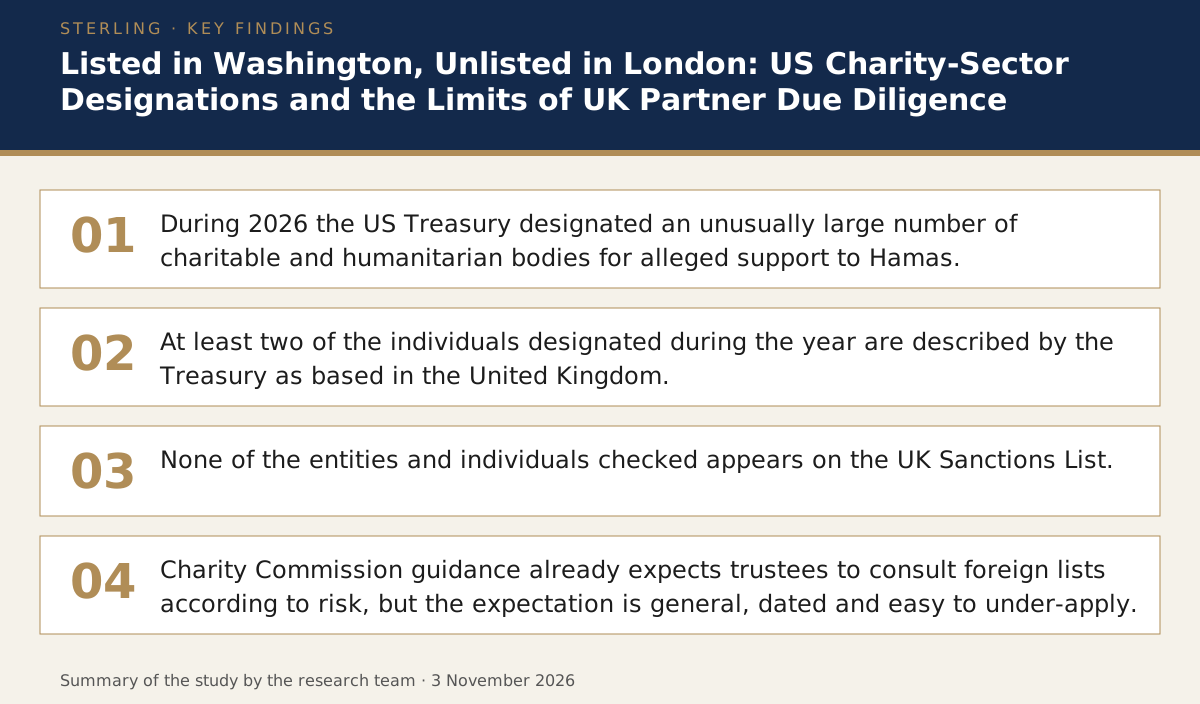
During 2026 the United States Department of the Treasury designated an unusually large number of charitable and humanitarian bodies as Specially Designated Global Terrorists for alleged support to Hamas. They include six Gaza-based organisations designated in January, nonprofit organisations in Türkiye and Indonesia designated in March and July, and two French associations designated in October. At least two of the individuals designated during the year are described by the Treasury as based in the United Kingdom.
The research team checked the published UK Sanctions List (report date 30 October 2026) for every entity and individual in those four Treasury actions that is discussed in this paper. None of them appears on it. In October 2026, according to the complainant, UK Lawyers for Israel, the Charity Commission for England and Wales opened a regulatory compliance case into a British charity, Restless Beings, after UK Lawyers for Israel alleged that the charity had worked with one of the Gaza organisations the Treasury designated in January. As quoted by UK Lawyers for Israel, the Commission has said that opening the case is not a finding against the charity.
This paper asks a measured policy question: when the United States lists an overseas charity and the United Kingdom does not, what exactly are British trustees required to do, and is the present guidance adequate? It concludes that the Charity Commission's guidance already expects trustees to consult foreign lists according to risk, but that the expectation is general, dated and easy to under-apply. It recommends five targeted improvements.
1. The question
UK charity law places the duty to safeguard funds on trustees. UK sanctions law makes it an offence to deal with designated persons. These two regimes meet cleanly when an overseas partner is on the UK Sanctions List: in the words of the Charity Commission, "A charity must never work with a partner designated in the UK" (Charity Commission 2022).
They meet far less cleanly when the partner has been designated by another government but not by the United Kingdom. That situation is no longer hypothetical or rare. The Treasury's 2026 actions have placed a cluster of Gaza-facing humanitarian bodies on the United States list, explicitly in order, as the Treasury put it in January, "to help reduce the overall terrorist financing risk in the charitable non-profit organization sector by informing the public about financing networks operating in support of terrorist organizations and activities" (US Department of the Treasury 2026a). British charities working in Gaza are among the intended audience for that information, whether or not London adopts the listings.
This paper does not consider whether any of the designated organisations in fact supports Hamas. The Treasury's statements are allegations made on an administrative record, and they are reported here as such. Nor does it assess the merits of the complaint against Restless Beings, which is a matter for the regulator.
2. What Washington did in 2026
Four Treasury actions in 2026 bear directly on the charitable sector.
21 January 2026. The Treasury designated six Gaza-based organisations: Waed Society Gaza, Al-Nur Society Gaza, Qawafil Society Gaza, Al-Falah Society Gaza, Merciful Hands Gaza and Al-Salameh Society Gaza. It stated that they "are organized by, and integrated into, Hamas's military wing", relying on "documentary evidence taken from Hamas offices after October 7, 2023". Of Merciful Hands it said that the organisation "is similarly controlled by the Hamas military wing" and that "some Merciful Hands funding, as well as specific instructions for its operations, are provided by the Hamas military wing". The same action designated the Popular Conference for Palestinians Abroad, which the Treasury says is "clandestinely acting on behalf of Hamas", and a United Kingdom-based senior official of that body (US Department of the Treasury 2026a).
The January release made two points of particular relevance to humanitarian actors. It said the designations were intended "to enable the continued provision of humanitarian aid to Gaza—subject to OFAC's humanitarian general licenses—by raising the public's awareness of these Hamas-controlled organizations". And it stated that many overseas donors to such bodies were "unwitting" (US Department of the Treasury 2026a).
12 March 2026. The Treasury designated three Türkiye-based nonprofit organisations (Ghazi Destek Dernegi, Hayat Yolu and the Palestinian White Hands Assistance and Solidarity Association) and an Indonesia-based charity, Komite Nasional Untuk Rakyat Palestina. It described a general model in which "a network of nonprofit organizations … ultimately channel assets to local charities in Gaza that are controlled by Hamas", and said Hayat Yolu "has been identified as an operational headquarters, banking and financial hub for the Muslim Brotherhood" (US Department of the Treasury 2026b).
23 July 2026. The Treasury designated a person it describes as "a United Kingdom-based senior leader of the Egyptian Muslim Brotherhood" and "Secretary General of the Muslim Brotherhood General Secretariat", alleging that he "supported the fundraising for U.S.-designated institutions like Filistin Vakfi and Hayat Yolu". It also designated an Indonesia-based fundraising body, a Gaza-based charitable society and a Türkiye-based money exchange (US Department of the Treasury 2026c).
2 October 2026. The Treasury designated two France-based associations, Association Baraka and Ensemble C Mieux, the two individuals it says run them, and a Gaza-based alleged member of the al-Qassam Brigades (US Department of the Treasury 2026d; Office of Foreign Assets Control 2026). That case is examined in a companion Ardent study and is mentioned here only as part of the pattern.
Taken together, the year's actions describe a deliberate United States strategy of naming, one by one, the humanitarian intermediaries it believes Hamas uses. The January release is explicit that the aim is partly informational: to warn donors and partners.
3. What London has, and has not, done
The UK's own position is narrower. Hamas itself, including the Izz al-Din al-Qassam Brigades, is on the UK Sanctions List, as are a number of Hamas leaders and financiers (Foreign, Commonwealth and Development Office 2026). HM Treasury has also used its domestic counter-terrorism regime against fundraising networks: in March 2024 it froze the assets of two individuals suspected of providing financial support to Gaza Now, together with companies they control (HM Treasury and Office of Financial Sanctions Implementation 2024).
Since 28 January 2026 the UK Sanctions List published by the Foreign, Commonwealth and Development Office has been "the only source for all UK sanctions designations", following the closure of the Office of Financial Sanctions Implementation's Consolidated List (Foreign, Commonwealth and Development Office, HM Treasury and Office of Financial Sanctions Implementation 2026).
The research team downloaded the UK Sanctions List in CSV format on 3 November 2026 (report date 30 October 2026) and searched it for the names, and common transliterations, of the 2026 Treasury targets discussed in this paper, including Merciful Hands, Waed Society, Al-Falah Society, the Popular Conference for Palestinians Abroad, Hayat Yolu, Association Baraka, Ensemble C Mieux and al-Zaq/Alzaq, together with the two United Kingdom-based individuals designated by the Treasury in January and July. None returned a match. The search was re-run by the Quality · Fact-Check desk and again by the research team on 3 November 2026 against the current file (report date still 30 October 2026), extended to aliases and addresses (for example Bouchekif, Seven Spikes/Tujah Bulah, El-Kahira and the French addresses); again there were no matches, only unrelated name collisions. This is a text search of the published file, not formal sanctions screening, and it must be re-run on the publication date. It indicates that, as of late October 2026, the United Kingdom had not mirrored these United States designations (Foreign, Commonwealth and Development Office 2026).
The absence of a UK listing is not evidence that the allegations are wrong. Governments list on different evidential thresholds, under different statutes and for different policy reasons. But it has a practical consequence: for a British charity, the criminal-law bright line does not apply to these bodies. What applies instead is the more demanding, and more ambiguous, standard of charity law.
4. What the Charity Commission expects
The Charity Commission's compliance toolkit, Chapter 1: Charities and Terrorism, last updated on 9 November 2022, sets out the expectations. It states: "Where the risks are high, in order to fully discharge your duties, you should check partners and individuals against the lists so as to ensure that a criminal offence is not committed by providing resources or support to a proscribed organisation", and adds: "Whatever the level of risk, it is good practice to do so." Among trustees' duties it lists the need to "take immediate steps to dissociate the charity from any activity that may give, or may appear to give, support to terrorism or terrorist activity" (Charity Commission 2022).
On foreign lists, the guidance is clearer than is often assumed. Its section on the international dimension states: "As a minimum, you should check individual country lists where public to inform your decisions, for example when working with a new partner organisation in a particular region. In some circumstances, you will be unable to comply with your legal duties if you do not do so. You should decide how many international lists to consult and how regularly to monitor these according to the level of risk the charity is exposed to." It explains the United States system, including Specially Designated Global Terrorist listings under Executive Order 13224 and the OFAC Specially Designated Nationals list, and advises that "if you plan to transact in US dollars or work with US persons or companies, check that you comply with US sanctions" (Charity Commission 2022).
The guidance also stresses that working through a local partner "does not, however, alleviate or shift responsibility for ensuring the proper application of the charity's funds by the local partner", that due diligence checks "should be undertaken by trustees prior to working with partners and checks made periodically where a charity has an ongoing relationship with a partner", and that "you must not engage in conduct or activities that would lead a reasonable member of the public to conclude that the charity or its trustees were associated with a proscribed organisation or terrorism in general" (Charity Commission 2022).
In short, the expectation exists. A trustee of a charity working in Gaza in 2026 would, on the Commission's own words, be expected to consult public foreign lists, and the United States list is the most prominent of them.
5. A test case: the Restless Beings compliance case
The case that brings these questions into focus was made public in October 2026. UK Lawyers for Israel, a campaigning legal organisation and the complainant in the case, announced on 16 October that the Charity Commission had opened a regulatory compliance case into Restless Beings (registered charity number 1135134, confirmed on the Commission's register of charities) following its complaint (UK Lawyers for Israel 2026; Charity Commission n.d.). The Commission has published no statement of its own in any source the research team opened. As quoted by UK Lawyers for Israel, the Commission stated: "Having reviewed the information you have provided, we consider that the concerns raised warrant further regulatory engagement with the Charity. Accordingly, a regulatory compliance case has been opened."
According to UK Lawyers for Israel, its complaint, which it says it submitted on 8 March 2026, alleges "serious failures of due diligence and possible breaches of charity and counter-terrorism law" by Restless Beings arising from its relationship with Merciful Hands Gaza. According to UK Lawyers for Israel, its report "documented apparent overlapping personnel and joint humanitarian projects involving Restless Beings and Merciful Hands Gaza between 2022 and 2024", including material from Ramadan 2022 showing Restless Beings branding, and a February 2024 post by Merciful Hands describing 450 meals, each intended for two people, "funded by Restless Beings". UK Lawyers for Israel says the complaint also cites material that, in its view, links Merciful Hands' former leadership and founding to Hamas figures (UK Lawyers for Israel 2026).
Three points of precision are essential.
- These are allegations by a complainant. UK Lawyers for Israel is a party with a stated position, and its dossier has not been tested. The research team has not reviewed the underlying material.
- The regulator has made no finding. UK Lawyers for Israel itself reports that "The Commission emphasised that opening a regulatory compliance case does not mean it has reached any findings against Restless Beings" (UK Lawyers for Israel 2026). A regulatory compliance case is a lower-tier step than a statutory inquiry under section 46 of the Charities Act 2011.
- The charity's position is not yet public in any source we opened. The Jerusalem Post reported on 18 October 2026 that "Restless Beings did not respond to an emailed request for comment by publication time" (Carson 2026). Before publication, Restless Beings must be sent a written right-of-reply letter with a fixed deadline, and its response, or its non-response with the date, must be included (see the right-of-reply recommendation and draft letter below).
Timing matters to the policy analysis. On UK Lawyers for Israel's account as complainant, the alleged joint activity ran from 2022 to 2024, before the Treasury designated Merciful Hands on 21 January 2026. A charity cannot have screened against a listing that did not yet exist. The relevant questions for the regulator are therefore likely to concern what public indicators were available before designation, what the trustees did after it, and whether any relationship continued. Those are precisely the questions on which the present guidance is least specific.
6. Where the guidance falls short
The Commission's guidance is sound in principle. Its weaknesses are practical.
It is dated. The toolkit chapter was last updated on 9 November 2022 (Charity Commission 2022). It predates the 7 October 2023 attack, the surge in Gaza-related giving that followed and the Treasury's 2026 programme of charity-sector designations. It also predates the 28 January 2026 move to a single UK Sanctions List.
It leaves the foreign-list duty to trustee judgement. The guidance tells trustees to decide "how many international lists to consult and how regularly to monitor these according to the level of risk". For a large, professionally staffed charity that is workable. For a small charity, often run by volunteers and responding to an emergency, it is an invitation to under-apply the standard.
It is silent on retrospective designation. The guidance says little about what trustees should do when a long-standing partner is designated abroad: whether to review past transfers, whether to file a serious incident report, and how to communicate with donors.
It does not address the two-tier problem. Where the United States has listed a body and the United Kingdom has not, trustees face a real dilemma. Ending the relationship may disrupt aid to civilians; continuing it may expose the charity to banking difficulties, reputational damage and regulatory scrutiny. The guidance acknowledges, in a different context, that a US designation may cause difficulties in "transferring funds abroad … particularly if they operate in US dollars and the designation is in the US" (Charity Commission 2022), but it offers no structured approach.
7. Recommendations
The research team suggests five proportionate measures. None requires legislation.
-
Refresh Chapter 1 of the compliance toolkit. The Charity Commission should update the guidance to reflect the single UK Sanctions List and the 2026 United States designations, and should state plainly that, for charities working in or funding activity in Gaza, consultation of the OFAC Specially Designated Nationals list is expected as a matter of course.
-
Issue a regulatory alert on retrospective designation. The Commission should set out what trustees should do when an existing or former partner is designated by a major allied government: review the relationship, consider a serious incident report, take professional advice and record the decision.
-
Explain the gap between lists. HM Treasury, the Office of Financial Sanctions Implementation and the Foreign, Commonwealth and Development Office should consider publishing a short note for the charitable sector on why the UK may not mirror particular US designations, so that the absence of a UK listing is not read by trustees as reassurance.
-
Support small charities. Screening against several foreign lists is cheap for large organisations and burdensome for small ones. The Commission could work with sector bodies to provide a simple, free screening checklist that covers the UK, UN, EU and US lists.
-
Right of reply as standard practice. Any published analysis that names a charity under regulatory review, including this paper, should first offer that charity a written right of reply with a deadline, and record its answer or its silence.
8. Conclusion
The United States spent 2026 naming the humanitarian intermediaries it believes Hamas uses. The United Kingdom, as of the end of October, had not followed. That divergence is a legitimate sovereign choice, but it shifts the burden of judgement onto British trustees, and the guidance that is supposed to help them was last revised four years ago. The Restless Beings case, whatever its eventual outcome, shows the questions the regulator will now be asking. Trustees deserve to know those questions in advance. A modest update to existing guidance would give them that, at little cost and with real benefit to public confidence in humanitarian giving.
References
Carson, Alex. 2026. "UK Opens Probe of Charity with Alleged Ties to Hamas Funding Front." Jerusalem Post, 18 October 2026. https://www.jpost.com/international/article-912087.
Charity Commission. n.d. "Restless Beings – 1135134." Register of Charities. Accessed 3 November 2026. https://register-of-charities.charitycommission.gov.uk/en/charity-search/-/charity-details/5000610.
Charity Commission. 2022. "Compliance Toolkit Chapter 1: Charities and Terrorism." GOV.UK, first published 11 June 2021 (page metadata), last updated 9 November 2022. https://www.gov.uk/government/publications/charities-and-terrorism/compliance-toolkit-chapter-1-charities-and-terrorism.
Foreign, Commonwealth and Development Office. 2026. UK Sanctions List (CSV format). Report date 30 October 2026. Downloaded and searched 3 November 2026 (text search, not formal screening). https://sanctionslist.fcdo.gov.uk/docs/UK-Sanctions-List.csv.
Foreign, Commonwealth and Development Office, HM Treasury and Office of Financial Sanctions Implementation. 2026. "Moving to a Single List for UK Sanctions Designations, 28 January 2026." GOV.UK, first published 13 October 2025, last updated 28 January 2026. https://www.gov.uk/guidance/moving-to-a-single-list-for-uk-sanctions-designations-28-january-2026.
HM Treasury and Office of Financial Sanctions Implementation. 2024. "New Sanctions on Persons Linked to Hamas-Supporting Media Network." GOV.UK, 27 March 2024. https://www.gov.uk/government/news/new-sanctions-on-persons-linked-to-hamas-supporting-media-network.
Office of Foreign Assets Control. 2026. "Counter Terrorism Designations." Recent Actions, 2 October 2026. https://ofac.treasury.gov/recent-actions/20261002.
UK Lawyers for Israel. 2026. "Charity Commission Opens Regulatory Compliance Case into Restless Beings following UKLFI Complaint over Hamas-Linked Gaza Charity." 16 October 2026. https://www.uklfi.com/charity-commission-opens-regulatory-compliance-case-into-restless-beings-following-uklfi-complaint-over-hamas-linked-gaza-charity.
US Department of the Treasury. 2026a. "Treasury Exposes and Disrupts Hamas's Covert Support Network." Press release SB0368, 21 January 2026. https://home.treasury.gov/news/press-releases/sb0368.
US Department of the Treasury. 2026b. "Treasury Continues to Disrupt Hamas' Sham Charity Network as the Group Refuses to Disarm." Press release SB0415, 12 March 2026. https://home.treasury.gov/news/press-releases/sb0415.
US Department of the Treasury. 2026c. "Treasury Disrupts Muslim Brotherhood and Hamas Financial Networks." Press release SB0572, 23 July 2026. https://home.treasury.gov/news/press-releases/sb0572.
US Department of the Treasury. 2026d. "Treasury Dismantles Major Hamas Financing Network." Press release SB0647, 2 October 2026. https://home.treasury.gov/news/press-releases/sb0647.