
Summary
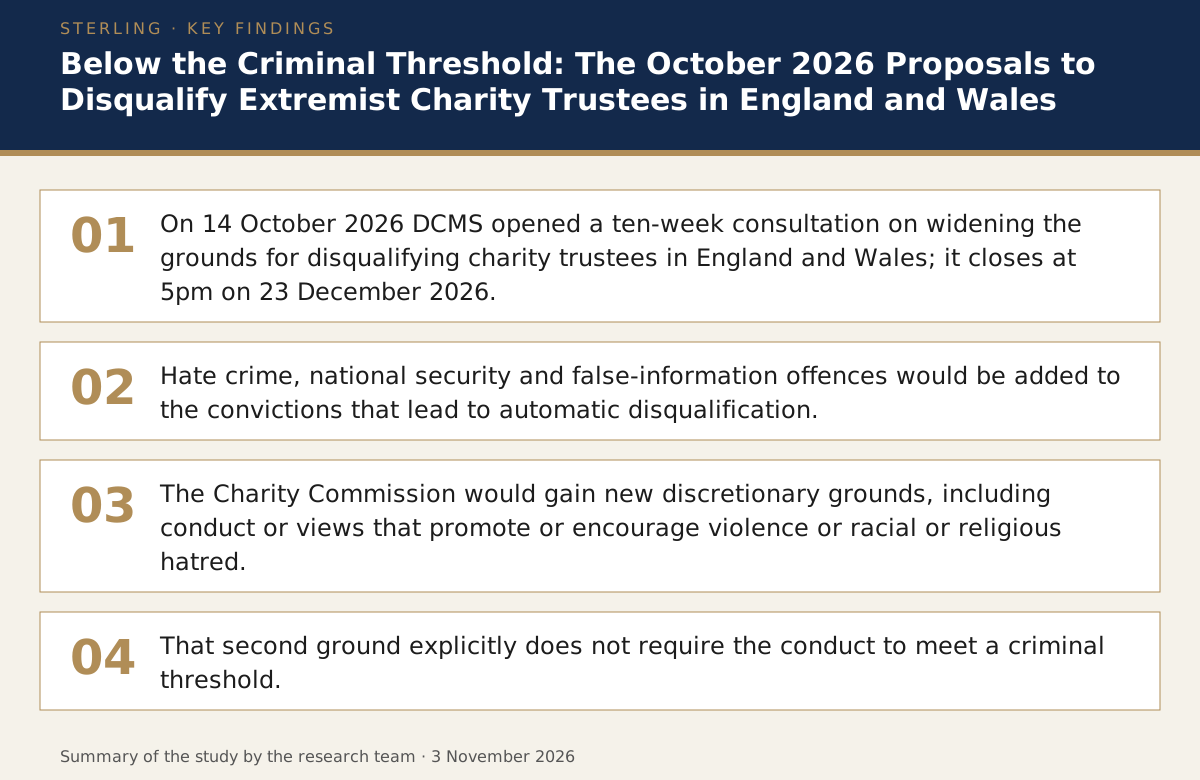
On 14 October 2026 the Department for Digital, Culture, Media and Sport (DCMS) opened a ten-week consultation on draft regulations that would widen the grounds on which people can be barred from serving as trustees or senior managers of charities in England and Wales (DCMS 2026a; 2026b). The consultation closes at 5pm on 23 December 2026.
The proposals have two parts. The first adds hate crime, national security and false-information offences to the list of convictions that lead to automatic disqualification. The second gives the Charity Commission for England and Wales two new discretionary grounds: deprivation of British citizenship or exclusion from the United Kingdom, and conduct or views that promote or encourage violence or racial or religious hatred. The second ground explicitly does not require the conduct to meet a criminal threshold (DCMS 2026b).
The package is modest in scope, but it is significant in principle. It comes from the government led by Prime Minister Andy Burnham, in office since 20 July 2026 (GOV.UK 2026). It reaches extremist conduct that is not itself criminal, and it does so through regulation of an existing institution rather than through a new legal definition of extremism. This paper sets out what is proposed, how it fits with the wider counter-extremism framework, and the questions that respondents and officials should press before the regulations are made.
1. The problem the proposals address
According to the consultation, there are more than 170,000 registered charities in England and Wales, with combined annual income of over £90 billion. The Commission already has powers to open statutory inquiries, issue official warnings, suspend or disqualify trustees and appoint interim managers, but "there is often a high bar that must be met before these powers can be exercised" (DCMS 2026b).
The government's announcement gives a measure of the casework. Since October 2023, the Commission has opened more than 400 cases examining potential wrongdoing in charities in the context of the conflict in the Middle East, and has made more than 80 referrals to the police (DCMS 2026a). The consultation states that hatred relating to race, religion or belief "makes up the vast majority" of the Commission's existing extremism casework (DCMS 2026b).
The existing discretionary power, section 181A of the Charities Act 2011, has been used to make more than 200 disqualification orders since 2016, including 25 in the financial year to 31 March 2026. Of 16 appeals heard by the Tribunal, the Commission's orders were upheld in all but two, although some were shortened (DCMS 2026b). The government says that, while the Commission can tackle extremist abuse within its current powers, "it is often resource intensive to do so and open to significant legal challenges or delays" (DCMS 2026b). In our reading, the difficulty is not that the Commission loses, but that many extremism cases have to rely on the catch-all "condition F" (conduct damaging to public trust and confidence). The consultation's own case studies describe that route as one that "can lead to significant challenge and delay" (DCMS 2026b).
2. What is proposed
2.1 Automatic disqualification (section 178A)
People with unspent convictions for the following would be automatically barred from acting as trustees or senior managers (DCMS 2026b):
- Hate crimes: stirring up racial hatred, and religious or sexual-orientation hatred, under sections 18–22 and 29B–29G of the Public Order Act 1986; and racially or religiously aggravated offences under sections 29–32 of the Crime and Disorder Act 1998.
- False or misleading information: the offence under section 60 of the Charities Act 2011 of supplying false or misleading information to the Commission.
- National security: offences under sections 1, 2, 3, 4, 12, 13, 16, 17 and 18 of the National Security Act 2023, section 1 of the Official Secrets Act 1911 and section 7 of the Official Secrets Act 1920. The last two were repealed and are included to capture earlier conduct. The consultation also refers to sections 17A–17C of the National Security Act 2023, inserted by section 2 of the National Security (State Threats) Act 2026. These create offences of supporting, assisting or obtaining material benefits from a designated body, under a regime modelled on proscription. They do not appear in the enumerated list of offences to be added, and DCMS should confirm whether they will be.
The government has obtained the Law Officer's consent for retrospective effect, so that existing unspent convictions would count, subject to a six-month transition (DCMS 2026b). Disqualification would not apply where a court has only imposed a sentencing uplift for hostility under section 66 of the Sentencing Act 2020, because the Commission cannot reliably see that information. The same applies to the foreign-power uplift under section 69A of the Sentencing Act 2020 (DCMS 2026b).
2.2 New discretionary grounds (section 181A)
Two new conditions would be added (DCMS 2026b):
- Condition EA: the person has been deprived of British citizenship under section 40 of the British Nationality Act 1981, or excluded from the United Kingdom, whether by an exclusion order under regulation 23(5) of the Immigration (European Economic Area) Regulations 2016 or by a direction of the Secretary of State on the ground that exclusion is conducive to the public good.
- Condition EB: the person engages in conduct or expresses views that promote or encourage, or would be reasonably likely to promote or encourage, violence, or hatred against a group defined by race or by religion or belief. The consultation states that the behaviour "does not need to meet the criminal threshold".
The consultation gives examples of conduct that would fall under condition EB. They include hosting speakers on charity premises who promote violence or hatred; a trustee calling for violence against, or the eradication of, a national, ethnic, racial or religious group in a sermon; trustees taking part in riots targeting places of worship; and trustees promoting "unfounded and hateful conspiracy theories" about a race, religion or belief group (DCMS 2026b).
The existing three-limb test and its safeguards would remain. The person must meet a condition, must be unfit, and the order must be desirable in the public interest. Notice, representations, a maximum of 15 years and a right of appeal to the Tribunal also remain. The new conditions would apply to conduct before the regulations come into force (DCMS 2026b).
The consultation cites two past cases to show the value of condition EA. One is the Commission's 2019 order against the preacher Zakir Naik, who had been excluded from the United Kingdom in 2010; the Tribunal upheld the order but halved its length. The other is an unnamed trustee deprived of citizenship in 2017 after being assessed as aligned to an al-Qaeda-aligned group (DCMS 2026b).
3. Where this sits in the wider framework
Three features stand out.
First, it avoids a statutory definition of extremism. The new condition is framed around violence and racial or religious hatred, which are concepts already familiar in law, rather than around ideology. The consultation is explicit that it is "not intended to capture mere offence or unpleasantness", nor to interfere with the free speech duties of higher education providers (DCMS 2026b). This is a narrower and more defensible approach than a general extremism test, but it also means that non-violent Islamist activity that does not promote hatred against a protected group will not be caught by condition EB.
Second, it complements, rather than replaces, proscription. The Home Office's statement on proscription policy, laid before Parliament on 26 October 2026, restates that a group may be proscribed only if the Home Secretary believes it is "concerned in terrorism", and that proscription is a discretionary step even when that test is met (Home Office 2026). Many of the cases that concern the public sit well below that threshold. The charity proposals target exactly that space: individuals, not organisations, and conduct, not terrorism.
Third, it is part of a longer programme. The government presents the consultation as part of the commitment set out in its Protecting What Matters action plan (DCMS 2026a). The consultation itself refers to the government's action plan on social cohesion of 9 March 2026, which promised further powers requiring primary legislation: extending the Commission's ability to suspend trustees and shut down charities, trustee ID verification and the digitisation of charity accounts (DCMS 2026b). The government says it is continuing to work with the Commission on what further powers may be needed (DCMS 2026a).
4. Questions for government
We suggest that respondents to the consultation, and parliamentarians scrutinising the regulations, press on the following points.
- Evidence standard. Condition EB applies to "comments made by or attributed to a person". What standard of attribution will the Commission apply, especially for online content, and will its updated guidance set this out before the regulations come into force?
- Organisational patterns. The proposals act on individuals. Where a charity repeatedly hosts speakers who promote hatred, what is the route to action against the charity itself, given that the stronger powers in the social cohesion action plan require primary legislation?
- Consistency across the United Kingdom. Charity law is devolved in Scotland and Northern Ireland, and the proposals apply to England and Wales only (DCMS 2026b). Will the government work with the Scottish Charity Regulator and the Charity Commission for Northern Ireland so that disqualified people cannot move across the border?
- Groups other than race and religion. The consultation says that extremist views not linked to race, religion or belief would still fall under condition F (DCMS 2026b). Is that sufficient? The consultation notes that aggravated offences relating to disability, sexual orientation and transgender identity will come into scope automatically once the relevant provisions of the Crime and Policing Act 2026 are commenced. Officials should set out when that is expected.
- Data. Will the Commission publish annual figures on the use of conditions EA and EB, including outcomes on appeal, so that Parliament can judge whether the powers are used proportionately?
- State-threat offences. The consultation refers to the offences in sections 17A–17C of the National Security Act 2023 (supporting, assisting or obtaining material benefits from a body designated under the state-threats regime), but they are not in the enumerated list of offences to be added. Will DCMS confirm whether they are intended to lead to automatic disqualification?
5. Assessment
The proposals are a careful, incremental strengthening of a regulator that already wins most of its contested cases. Their main value is speed and certainty. Automatic disqualification requires no action by the Commission, whereas a discretionary disqualification can cost it approximately £7,000 (DCMS 2026b, "Supply of false or misleading information to the Commission"), and condition EA lets the Commission rely on a Home Secretary's decision rather than rebuilding the case under condition F.
Their main limitation is scope. They deal with the most visible cases, such as hateful sermons, incitement and convicted offenders, but not with the organisational and financial questions about influence networks that now dominate European debate, from the European Parliament's resolution of 8 October 2026 to national inquiries elsewhere. For a government audience, the most useful outcome of this consultation would be a clear timetable for the primary legislation promised in March, together with published guidance on condition EB that protects lawful religious and political speech.
References
DCMS (Department for Digital, Culture, Media and Sport). 2026a. "Consultation on Powers to Protect Charities from Extremist Abuse." News story, DCMS and Vicky Foxcroft MP, 14 October 2026. https://www.gov.uk/government/news/consultation-on-powers-to-protect-charities-from-extremist-abuse.
DCMS (Department for Digital, Culture, Media and Sport). 2026b. Consultation on the Extension of the Charity Commission's Powers to Tackle Extremism. 14 October 2026. https://www.gov.uk/government/consultations/consultation-on-the-extension-of-the-charity-commissions-powers-to-tackle-extremism/consultation-on-the-extension-of-the-charity-commissions-powers-to-tackle-extremism.
GOV.UK. 2026. "Prime Minister." Accessed 3 November 2026. https://www.gov.uk/government/ministers/prime-minister.
Home Office. 2026. Statement in Relation to the Secretary of State's Powers under Section 3 of the Terrorism Act 2000. Presented to Parliament pursuant to section 240 of the Crime and Policing Act 2026. 26 October 2026. https://www.gov.uk/government/publications/proscription-policy-and-process-statement/statement-in-relation-to-the-secretary-of-states-powers-under-section-3-of-the-terrorism-act-2000-accessible.